
Wayward Weekly Wisdom (W³) - Issue I
A Weekly Practice of Awareness

First off. Wow!
I didn’t expect to reach 100 leaders here in this space to subscribe to Wayward Purpose.
Thank you to everyone who has been a part of this so far. It means a lot that you’d trust me with a few minutes of your attention in a world that’s constantly loud. I feel like now is the right time to reintroduce myself and talk about where Wayward Purpose is heading.
So, who am I?

I’m a father of four, raising a family where ADHD is part of everyday life. I’m a man of faith, Christian, Catholic, doing my best to live what I believe. I’m a senior enlisted leader in the Space Force, with roots in the Air Force, and I spend time coaching and mentoring leaders. I’ve learned as much from listening, following, and failing as I ever have from leading.
I live with ADHD myself and have spent years in therapy doing the work of understanding my own grief, loss, shame, and moral injury so I can show up better for my children, my wife, and for others. I’ve seen what happens when people give themselves fully to something that matters but never learn how to recover from the cost.
That tension is what led me to build what I call Wayward Purpose.
At the center of all of this is a question I keep coming back to:
How can those who serve wholeheartedly turn moral injury into deeper purpose instead of self-destruction?
I’ve seen what happens when that question goes unanswered. I’ve also lived what becomes possible when people are given language, space, and practices that help them integrate their experiences instead of burying them.
So what does that mean for this new weekly series?
One of my daughters is in competitive dance, and I’m a full-on dance dad with a jersey to prove it 😂. I’ve noticed her instructor never teaches the entire routine at once. They play the song, give a few counts, and work it piece by piece. Showing the whole dance too early would overwhelm the dancers and create more mistakes than progress.
Vision works the same way. Holding the entire picture all at once can be heavy. Not everyone needs (and as I have learned even wants) the whole thing right away.
That’s why I’m starting this year with the first part of the Wayward framework in this weekly newsletter: Wisdom.
Wisdom is about awareness. The learning where you are before worrying about where you’re headed. Knowledge is knowing the stove is hot. Wisdom is choosing not to touch it. This step sounds simple, but it’s the foundation for everything that follows here. It’s also what allows moral injury to begin turning into moral leadership.
I don’t buy into the idea of “self-help.” The notion that we can pull ourselves up by our bootstraps is a myth. If you don’t believe me, try lying on the floor with your shoes on and pulling yourself up by the laces.
I’ll wait. 😂
So, just like my daughter’s instructor doesn’t reveal the full dance on day one, I won’t lay out the entire Wayward framework yet. We’ll start with wisdom and this weekly newsletter. The rest will come in time.
Going forward, this weekly piece will include a short reflection from my week, one insight I’m sitting with, where I’ve been spending my time and attention, and one question to carry into your days ahead.
Honestly, we don’t need more information. We don’t need more noise. And we don’t need motivation that never turns into change. What we need is deeper awareness, real accountability, faith, direction, discipline, and simple frameworks that lead to transformation and deeper purpose.
So, with that said, here we go with the first one.
W³ Reflection
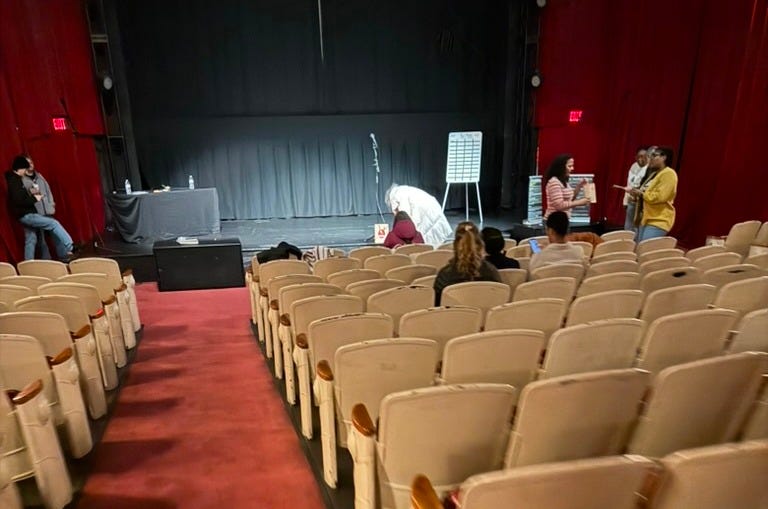
This year began with a new job, a new working group, a deeper commitment to my faith, and a stage. At the beginning of this year, while working through grief I’m still carrying, I decided to step into a room and put my name in a “hat” to step onto a Moth Story Slam stage for the first time. I prepared a personal story of sitting in an operating room waiting for my mother to die, and how, months later, I realized what I witnessed wasn’t her death, but one final act of parental love (I wrote about that here).
This year, my work has continued with Wayward Purpose and to help me ground it in something more tangible, I’m committing to this Weekly Wayward Wisdom practice as a way to hold myself accountable to those of you who’ve trusted me with your time and attention.
At its core, this work is about transforming moral injury into moral leadership, and those moments when your values or sense of right and wrong are trampled, and how that injury can either hollow you out or become the ground where real leadership grows. My working theory is simple, but not easy:
Moral injury can turn into moral leadership, but only when people are supported in building three things and doing the hard work.
Faith. Not as something compartmentalized, but as a daily practice. I used to pray only when something went wrong or I needed help. Now, morning prayer and Scripture have become a way to align my values before the day begins, and carries me through them.
Direction. Not certainty, but alignment. There is very little in this world we can actually control. I’ve learned to set small, realistic goals and waypoints that reflect my long-term values, who I am, and then regularly adjust course as life changes.
Discipline. Not punishment or control, but daily choice. Simple routines, less screen time, movement, journaling, time with my family, praying, mindfulness, and create consistency to help make my personal growth sustainable.
Practiced together, faith, direction, and discipline bring steadiness, presence, and deeper purpose. They shape how we show up at home, at work, and in our communities.
That’s part of why I began Reach More Mission Training this week, and glad I was selected for the opportunity. The Scripture reading this week reminded me how easily I compartmentalize. One practice I’ve been learning now, called Lectio Divina, has reinforced a shift I’m trying to live in my daily praying. It’s practice that prayer is not an occasional act, but as something that should run through the whole day. Not reacting to chaos, but responding with intention. Not shelving faith, but letting it shape how I move through my life.
Both responding instead of reacting, and choosing intention and presence over making everything about what happens to me, are where I’ve been focusing my attention.

W³ Insight
I keep hearing the same line paraphrased lately that we need to make sure to schedule our priorities, and not prioritize our schedules. The more I hear it, the more I realize how often we say we have priorities when, in reality, we only ever live one. What we give our time to is what we’re saying matters and what is important to us.
Now, I’ve watched what happens when someone is buried under responsibility, identity, and pressure and then slowly begins to choose presence and connection instead. They end up rebuilding meaning. They reconnect with people. They stop retreating inward.
The even greater thing to see and witness is when people who live with intention start responding instead of reacting because thats were self-destruction starts to lose its appeal. Suicide shows up most often when people are isolated, exhausted, and disconnected from meaning. Suicide is also a false solution that appears when someone feels like they’ve run out of options. And the entire topic is something we still struggle to talk about honestly.
Which is another reason I am doing the work I am doing here.
Now, when I write here, I’m thinking of leaders like you; and me.
The service member.
The veteran.
The nurse.
The police officer.
The teacher.
The parent.
The people pleaser.
The one who has always had a tough time setting boundaries.
The one whose brain never really turns off.
The leader who stayed longer than was healthy out of duty or responsibility.
I’ve learned the hard way that when identity is built only on role or performance, even questioning it can be destabilizing. Losing it can be crushing. I’ve seen this in my own life and in others. I’ve coached many people who care deeply, who have stayed longer than is healthy, and those who have confused exhaustion with virtue.
We’re not the kind of people who burn out because we stop caring. We don’t go out like candles. Our flame doesn’t disappear unless we let it. For people like us, the issue what’s left in our cup. Every cup is always full. The question is what it’s filled with.
Sometimes it’s purpose.
Sometimes it’s resentment or bitterness.
Sometimes it’s just air.
Most people talk about the straw that broke the camel’s back. For moral injury, I don’t see a final straw. I see an empty cup, left only filled with air, poured out again and again, with nothing of substance refilling it. Not because they were weak or disengaged, but because they’ve given everything they had.
Most people never call this moral injury. They just say they’re tired. Or numb. Or angry. Or that something feels off. That’s more common than we admit, and you’re not alone in it.
For me, hitting that place meant I needed a way to make sense of what I was carrying. The framework I built for myself helped me stay whole, and I’ve seen it help others too as I have been walking some people through it with me.
As Brené Brown points out, “The irony is that we attempt to disown our difficult stories to appear more whole or more acceptable. But our wholeness, even our wholeheartedness, actually depends on the integration of all of our experiences, including the falls.
Now, I’ll be the first to say I’m not here to fix anyone.
I’m not a clinician, a doctor, or a savior. I’m just someone who’s spent time in the dark, carried moral injury, figured out what I believe, and came back with a deeper sense of purpose. I can help facilitate growth and evoke awareness, but I can’t “fix” you.
But the thing I keep coming back to is that it all starts with awareness and wisdom.

W³ Attention
The truth of the matter is that you always know the right thing to do. The hard part is doing it.
— Norman Schwarzkopf
I’ve used this quote in leadership papers over the years. Reading it again now, I find it interesting by how well it names moral injury even without the language for it.
A farmer can’t make a seed grow by talking to it.
A surfer can’t create waves.
You can’t help a plane take off by flapping your arms inside the cabin.
What you can do is prepare and plant seeds at the right time, tend the soil, wait for the wave, and plan the route. Action still matters, but it has to match reality and what you can actually effect (or is it affect - who honestly knows).
I’ve been thinking about what “priorities” are this week, and the construct of time lately. Not the priorities we say out loud, or the lists we make, but the ones revealed by where our time actually goes. I’ve heard the line a lot lately that you need make sure you “schedule your priorities, don’t prioritize your schedule” many times, and I’m realizing how often we really only live one priority at a time. Everything else competes with it. So do we really have such a thing as priorities, or can there only be one? This is a thought for another time, and a long essay I am working on.
Time though feels a lot like a vending machine. If you keep putting money in and nothing ever comes out (too much doom scrolling, huh?), eventually you would stop feeding the vending machine your money.
I used this analogy with my daughter this week on putting in “money” to people who are just mean back, but I’ve also been paying closer attention to what gives life back with my time I give. Going forward, I want to use this space here in the newsletter to continue to share where my attention has actually been, and what’s been worth it for me in hopes that it helps give you back some time in searching for things to spend your time on.
Most days, I spend two to four hours in the car between work, school, errands, and kids’ activities. Instead of letting that time disappear, I’ve been filling it with audiobooks and podcasts through Libby, Spotify, and the Hallow apps. I’ve deleted several other apps recently on my phone and made a simple rule that if something really matters, I sit down at a computer. These three apps made the cut to stay on the phone 😂.
Anyway, a few things that shaped my thinking and me this week:
Podcasts: I’ve been listening to episodes of Soul Boom and The Learning Leader Show, while continuing the Daniel Fast with my kids using the Hallow app as we move toward Lent. Soul Boom is great comical idea of faith through Dwight from the Office (doubt you know his real name). The Learning Leader Show is probably the one podcast I recommend to any leader out there to add to your daily mix. I also really enjoy the Hallow app, and all the challenges and series on there.
Movie: As a family, we watched The Mitchells vs. the Machines on Netflix this week and we loved it. Definitely one we will watch again a few times. All I could think the entire movie was, yep this is pretty much our family, lol.
Reading: Alongside daily Scripture, I’m working through Reach More Mission Training and The Love Dare with my wife. The Love Dare has been great for getting back to basics in our marriage, and focusing back on each other. I’m also reading Outwitting the Devil and Stand and Deliver, which are both more for professional reasons. When I am winding down at night I normally like to go with fiction, and currently I am reading Red Rising. I’m a huge nerd, so it scratches that itch very well.

A Questions For You:
Where in your life are you still feeding a vending machine that’s clearly broken (Out of guilt, habit, or hope)? What would happen if you just walked away and put your time into something that gives back? (Perhaps a relationship, a marriage, a book, a workout, a prayer.) Whats that look like for you?

Thank You For Backing The Work
Your time and trust gives this space room to exist, and that’s not lost on me.
If you’ve made it this far, thank you. Seriously. Everything here returns to one main goal to help transform moral injury into moral leadership so self-destruction is never the answer.
This is the first attempt at this new letter, so hopefully you give me some grace.
If you’re up for it, do me a favor and leave a comment. Just say hello. It helps me know you’re real and that you actually want to read this. Always open to feedback as well.
If you’d like to back this work and join the community, consider subscribing. There’s nothing behind a paywall, and I don’t plan to put anything there. Think of a subscription as buying me a monthly coffee so I can keep doing this work and, hopefully, help someone find words for what they’re carrying.
If a subscription isn’t right for you, the ‘Back the Work’ button below is an easy way to do a one time contribution and help ensure these conversations continue. Everything I do here is to help those survive moral injury and come back with deeper purpose instead of self-destruction.
Follow, subscribe, back the work, or just pass this onto someone you think it will help. Regardless of what you do with this information going forward, I’m grateful you’re here. Take care.
This perspective on moral injury and filling your cup really resonates. I've definately seen people confuse exhaustion with virtue in my own circles, and that vending machine analogy is perfect for thinking about where we actually spend our time. The emphasis on awareness as the starting point makes sense, especially when so many people are just trying to survive without realizing they're runing on empty.